May 5 — The Day I Finally Started to Understand “Flight”
 viva-wingfoil
The moment wing foiling became a control problem instead of pure chaos
May 5th, Children’s Day.
My third Enoshima session during Golden Week.
This ended up being a very special day for me.
Not just because I rode longer than ever before, but because for the first time, I started to truly understand:
- why the board flies
- how stability actually works
- and what I need to control to keep foiling consistently
Up until now, most of my foiling felt like controlled chaos — moments of success mixed with random crashes.
But this session felt different.
For the first time, wing foiling started to feel less like luck… and more like engineering.
The forecast looked perfect… until I arrived
The forecast called for:
- North wind in the morning
- South wind at 4 m/s in the afternoon
- Increasing to 5 m/s later in the day
For a beginner, that’s basically ideal.
At 4–5 m/s:
- a 6m wing should foil with pumping
- and around 5 m/s, maybe even without much pumping
Plus, with north wind in the morning, I expected relatively small waves compared to the massive surf from the previous session.
So I arrived at Enoshima around 1:30 PM feeling optimistic.
But the moment I saw the water…
“No way. This is way stronger.”
It looked more like 6–7 m/s already.
Windsurfers were fully powered up and flying across the bay.
So my original plan for the 6m wing immediately changed.
Instead, I rigged:
- a 5m wing
- and a 4m wing
Just in case.
That turned out to be the right call.
My “secret weapon” of the day
This session also had another big milestone:
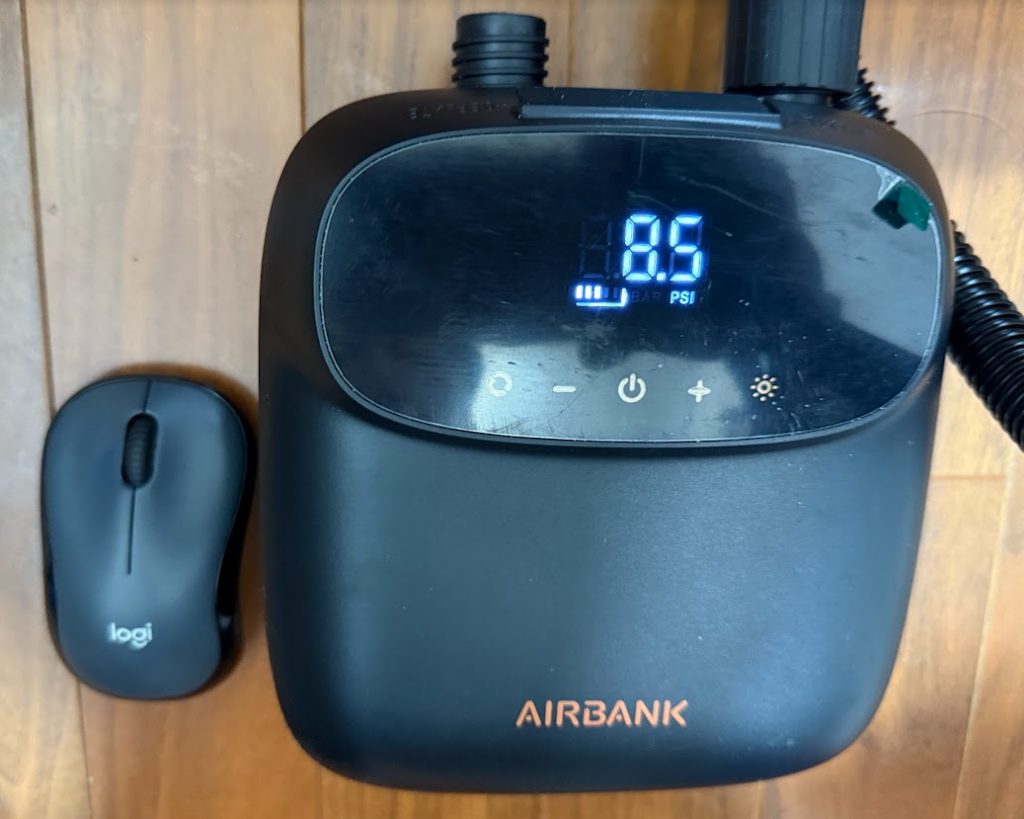
I finally bought an electric pump.
Anyone who does wing foiling knows this part well — inflating the wing is actually exhausting.
Especially the last few PSI.
Usually by the time I’m ready to launch, I’m already sweating and tired.
So I bought a battery-powered electric pump.
It cost around $110 and weighs about 1.3 kg.
Honestly, I thought:
“Pretty expensive… and kind of heavy.”
And then, of course, I made a mistake.
I forgot my manual pump.
My original plan was:
- electric pump for the bulk volume
- manual pump for the final high pressure
But since I forgot the manual one, I had no choice.
I tried using only the electric pump.
Surprisingly, it worked perfectly.
At some point the motor sound changed, switched into high-pressure mode, and slowly pushed the wing all the way to the target PSI.
That thing was amazing.
No sweating.
No wasted energy.
And I could prep the rest of my gear while it inflated.
Honestly, huge upgrade.
The conditions were perfect for learning to fly
I ultimately chose the 5m wing.
The waves were manageable — not tiny, but not dangerous.
As soon as I got on the water, I knew:
“This is a good day.”
The wind had enough power that just bearing off slightly gave instant acceleration.
Which meant I could easily enter the speed range needed for foiling.
I stayed on the water for about three hours total, from roughly 2:30 PM to 5:30 PM.
And it became the most productive wing foil session I’ve ever had.
“Getting up” was no longer the problem
This was the biggest mental shift of the day.
Before, the challenge was:
“How do I even get the board to lift?”
But now?
I could already do that pretty consistently.
Once I bore off and accelerated, the board would lift almost immediately.
So the problem had changed completely.
The new challenge was:
How do I stay flying?
That’s a huge difference.
Riding perfectly centered actually made things worse
My main focus that day was riding centered on the board.
But once I started foiling, something strange happened.
When I stood perfectly centered, the wing would pull me downwind, causing the board to roll and carve away uncontrollably.
Then I remembered something I had heard on YouTube:
“Lean slightly upwind.”
So I tried:
- placing my weight slightly upwind of center
- and tilting the board slightly upwind
Suddenly everything became more stable.
That was a massive breakthrough.
Why did it work?
I think the physics are pretty simple.
The wing generates force above your center of mass.
So if you stand perfectly centered, the pull from above creates a rolling moment that tips the board downwind.
To counter that, you actually need a slight upwind bias in your body position.
It’s basically a balance of forces and moments.
At that moment, wing foiling stopped feeling random.
It started feeling mechanical.
The huge difference between E-foil and Wing Foil
Another thing became clear that day.
On E-foil, control inputs mostly come from your feet:
- front foot pressure
- rear foot pressure
- left/right balance
That’s basically it.
But wing foiling is different.
The wing itself also becomes a control surface.
You can influence:
- pitch
- roll
- front/back balance
- left/right balance
using both:
- your stance
- and the wing position
So now there are effectively two control systems interacting at once.
That realization was fascinating.
During this session, I experimented mostly with controlling stability through the wing itself rather than aggressive foot inputs.
And it worked surprisingly well.
My first real long-distance foil ride
At one point, I finally connected a real ride.
Not just a tiny hop.
Not just a brief touch-and-go.
A real foil run.
Probably around 300 meters.
Sure, there were occasional touchdowns.
But I was legitimately flying.
And this was in Enoshima chop and swell — not flat water.
That gave me a huge confidence boost.
Enoshima is actually a difficult learning environment
One thing became very obvious:
Enoshima is hard.
There’s always swell.
Always movement.
Always disturbances entering the system.
On flat water, I honestly think I could probably ride much longer already.
But here, every wave introduces external input disturbances that constantly require correction.
And I could clearly feel:
- too much correction → overcompensation crash
- too little correction → instability crash
It honestly felt like tuning control gain parameters.
Almost like PID tuning in real life.
Still very “beginner style”
That said… I know I still look awkward.
My stance is too low.
Definitely a bit of a “survival posture.”
The advanced riders look relaxed and effortless.
I’m still fighting the board.
Still trying hard to stabilize everything.
So there’s still a long way to go.
But this was clearly a new stage
Even so, this session was a breakthrough.
Longest distance.
Longest flight time.
Most stable foiling yet.
But more importantly:
I started understanding why things work.
And that changes everything.
…and then I slammed my ribs
Of course, not everything went smoothly.
About an hour into the session, I crashed and slammed my chest into the board pretty hard.
My lower ribs hurt badly afterward.
Still painful the next day.
Hopefully nothing is broken.
But honestly?
Even with that, this session felt huge.
From “getting up” to “staying up”
Before, my goal was simply:
“I want to foil.”
Now the goal has changed.
Now it’s:
How do I stay flying consistently?
That’s a completely different stage.
And for the first time, wing foiling stopped feeling random.
It started feeling controllable.
That was the real breakthrough of the day.
\ 最新情報をチェック /